
Stillwater Associates is out with a timely report when cost concerns are paramount across the board. The analysis was commissioned by Clean Fuels Alliance America to answer a straightforward question: How have clean fuel programs performed relative to expectations? The answer, as it turns out, is very well.
In almost every state considering a Clean Fuel Standard bill, the first question is about cost. That’s always been the case, but it’s even more at the forefront when consumers are getting squeezed from every direction.
Before getting to the new analysis, a bit of history.
In 2022, the LCFC asked Bates White Economic Consulting to evaluate the relationship between credit prices in the California LCFS program and retail gasoline in the state. That study found a few things:
LCFS credits have had relatively little impact on retail gasoline prices compared to factors like oil prices and taxes, so there is no correlation between credit prices and gas prices
Fuel market dynamics resulting from greater fuel diversity and supply help mitigate any pass-through costs
Fuel market competition has resulted in consumer savings by increasing availability of alternatives to petroleum-based fuels that are regularly cheaper—especially when gas & diesel prices spike like we’re seeing now
Now we have another important addition to the reality check against recurring—and unfounded as we will see—apocalyptic claims of price effects from clean fuel programs.
Stillwater dug through the documented cost projections in CA and WA to compare those to what actually transpired. It turns out that the policies are a win-win. We already knew that both state programs have outperformed GHG emissions reduction targets. Now we can definitively say that overperformance came with far than lower than anticipated cost. Win-win!
The graphs tell the story
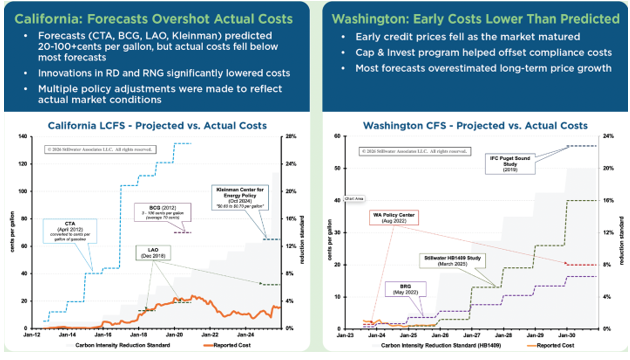
Stillwater also identified and expanded on mitigating factors highlighted by Bates White. In addition to the unanticipated cost dampening effect of diverse new clean fuel supplies, the report noted the innovation surprises that have characterized these programs. Fuel mix assumptions have been repeatedly upended by the market doing what it does best. It’s the fuel version of the adage ‘if you build [the policy], [companies] will come’.
The full report is available here. There’s also a handy 1-page [infographic summary]to spread the good news far and wide.