
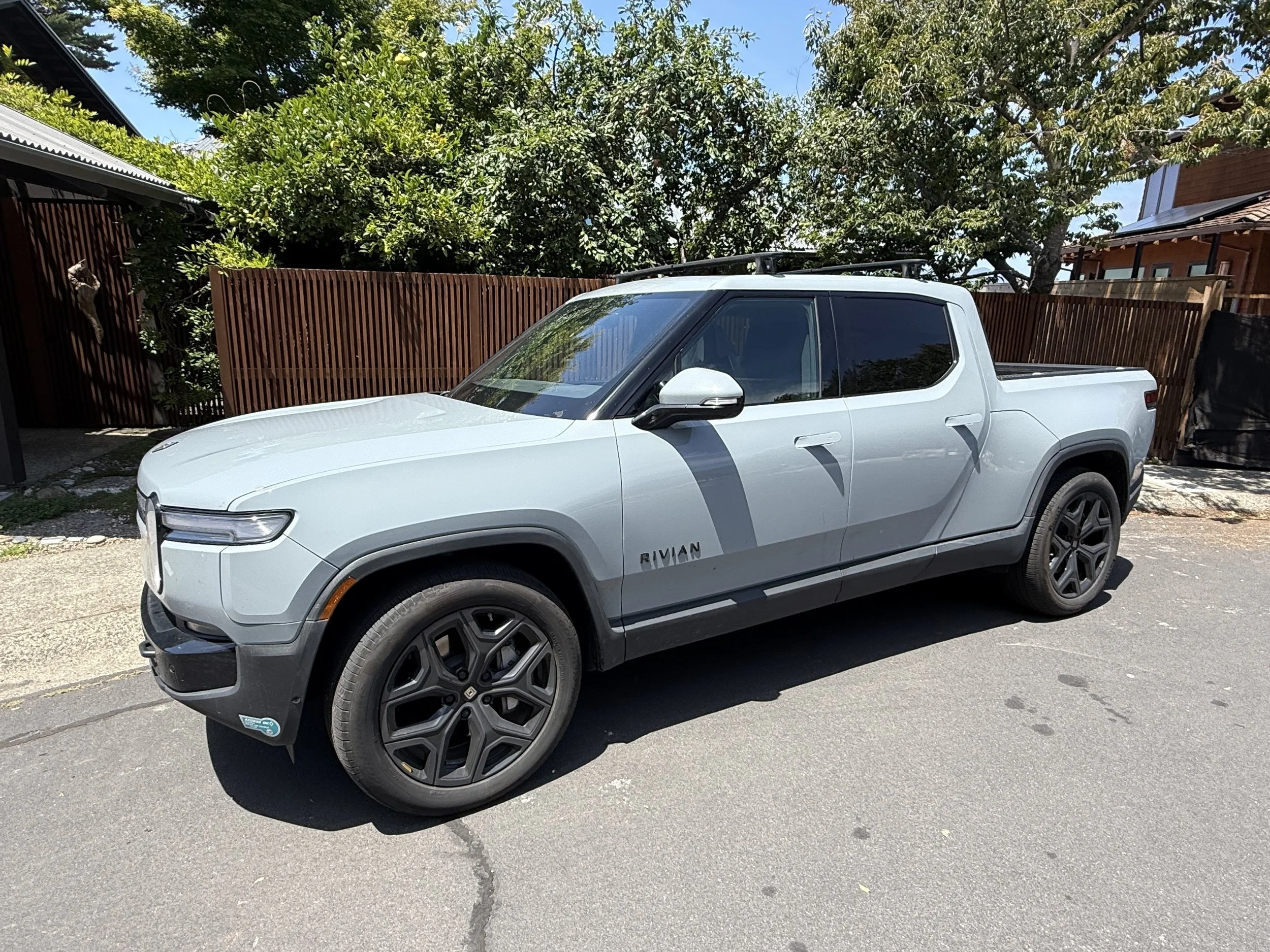
Gas prices are knocking at $7 per gallon in my county. Not surprisingly, I'm getting approached more often while climbing in or out of my electric truck. They're other old guys, mainly, who want to know how much my truck costs to charge up, and what range I get, because, you know, they're paying $7 per gallon. I give the math: the truck's 141.5 kWh battery costs 22 cents per kWh to charge at home, off-peak hours, which gets me about 360 miles. There's silence, then, while the guy works the arithmetic. If he's done it right, he'll either lament or joke that he pays about twice as much to get around as I do. Then we maybe nod or shrug, two guys in front of Safeway conceding they know nothing about almost everything. And that's it.
What I don't get to, in such short discussion, is the true cost of operations. Some added features:
I often drive long freeway miles, and the charging stations I use en route can cost three times per kWh more than what I pay in my driveway.
My truck sits on a queen-size battery that weighs nearly a ton. As a result I'm buying new tires only slightly less often than dog kibble.
With such weight and huge batteries, EVs get in fewer collisions that are mere fender benders. EV insurance premiums run 40 - 50% higher than for similarly priced ICE vehicles.
The yearly registration fee includes an extra hit to cover the gas taxes that California no longer collects from me.
On the other hand, because I no longer use gas stations, my beef jerky expenditures have dropped to zero. Charging stations are seemingly hard to locate near a convenience store (or a restroom, or a garbage can, or shade).
Indeed, the "value" I get from driving my EV owes almost nothing to the cost of fuel. I simply derive great satisfaction from a combination of zero emissions, quick acceleration, and a quiet ride.
We know the shortcomings of using pump prices as a key metric for evaluating the impacts of a war, the effectiveness of a president, or the value of a Low Carbon Fuels Standard program. Alas, in California this spring, legislators launched two proposals that would have sacrificed the success of the state's landmark LCFS for the sake of addressing high gas prices.
One bill sought to prohibit any changes to the program that would raise gas prices by two cents per gallon, despite whether a change could produce outsized reductions in emissions, incentivize new projects or jobs, or even whether greater competition among fuels ultimately lead to lower fuel prices. The other bill proposed to simply suspend the LCFC for a period of one year, irrespective of whether the supposed "savings" were greater than the inevitable of cost shutting off and on some production facilities, distribution networks, and so on.
Neither bill advanced far. Ironically, the sharp impact on gas prices from the Iran War seemed to momentarily overwhelm concern about the incidental costs associated with
the LCFC. Even so, the outcome for two bills, however appropriate, did nothing to discredit the overall gas price narrative. Gas prices are of course important, especially in their impact on people who must spend disproportionately more of their income getting from A to B. And they are the one price most of us see every day, updated on the digital scoreboard at gas stations.
But for now, even among policymakers who should know better, the "price of gas" still too often stands as a general indicator for societal and economic health. In a world under stark threat from climate change, and with the opportunity to switch policies to promote energy security, fuel diversity, and economic development, we need longer conversations than that if we're going to move further along.