
Farmer’s Almanacs have historically marked mid-July to mid-August as the hottest period of the year, i.e., the “Dog Days of Summer” (a reference to the Romans, who believed that Sirius, the “dog star,” was brightest then, and therefore added to the sun’s heat). Here in San Francisco, our August is notoriously foggy and cold, so Summer is only now beginning.
Our local rising temperatures have been matched by a scalding rise in diesel prices, which (as of the writing of this blog post) have now reached a record average high of $6.28 per gallon nationally, per the U.S. Energy Information Administration’s Gasoline and Diesel Fuel Update. Thanks to the war the U.S. began against Iran over six months ago, diesel prices are now 60% higher than the same time last year. It’s worth noting that the prior peak was set in 2022, after Russia started its own war with Ukraine.
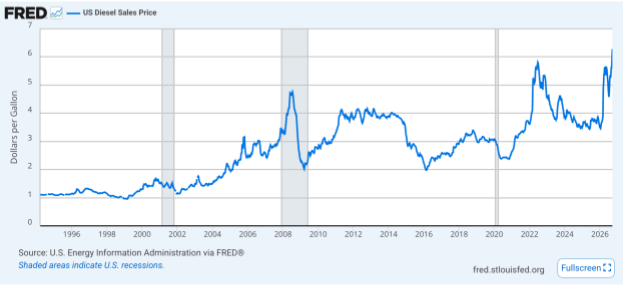
Source: Federal Reserve Bank of St. Louis
If only there were a cheaper, cleaner, American-based fuel alternative to break our dependence on a commodity subject to the disruptions of geo-political conflicts. As it turns out, in California, per the most recent 2025 analysis, between 70 to 80 percent of CA’s diesel is already non-petroleum based. Golden State drivers of heavy-duty engine vehicles, unlike drivers in all but two other states (Oregon and Washington), have had access to a sustainable, diesel drop-in alternative for their heavy-duty engines for nearly a decade.
The remarkable rise of non-petroleum diesel in CA since 2017—whether from renewable diesel (hydrotreated fatty acids) or, to a lesser degree, biodiesel (fatty acid methyl esters)—is best understood as a direct market response to the credits available to fuel producers for cutting their fuels’ greenhouse gas emissions (GHG). Under the Low Carbon Fuel Standard (LCFS), fuel makers who meet and/or exceed the state’s long-term carbon intensity (CI) reduction targets, as measured by full life cycle analyses, have an incentive to compete and increase their clean fuel supply.
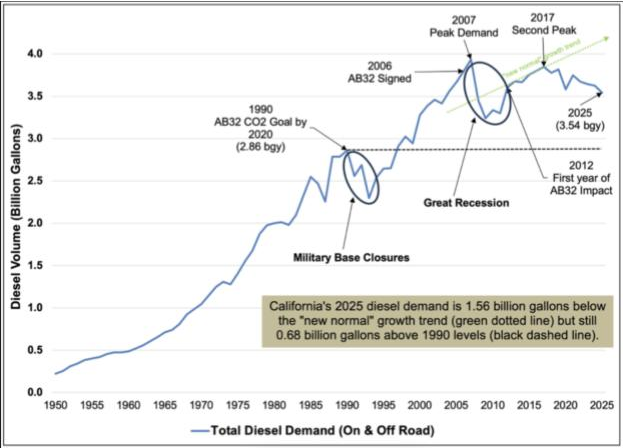
Source: Stillwater analysis of Board of Equalization, EIA, and LCFS fuel volumes
Thanks to the LCFS, which deploys the power of competition and ensures long-term predictability for capital investments, and with credit values from clean fuel standard markets, the average wholesale cost of non-petroleum diesel in CA, OR, and WA can also come in under the cost of traditional diesel.
Moreover, because renewable fuels have now displaced at least 71% of the state’s petroleum diesel pool, GHG emissions from diesel have far outpaced (overachieved) the projected CI reduction targets for transportation fuels set by LCFS, as part of the state’s landmark climate action policy (AB 32), without any disruption whatsoever to the state’s drivers.
The fact that diesel is one of the largest contributors to inflation (it fuels the trucking and rail and is a vital supply chain element in sectors as diverse as agriculture, construction, and mining), means that higher pump prices raise the cost of moving practically all basic goods. This directly contributes to raising the overall inflation rate, as higher shipping, farming and manufacturing costs are passed directly onto consumers.
After six months of conflict, there does not appear to be an end in sight to this latest war of choice and the resulting chokehold on petroleum supplies through the Strait of Hormuz (and recently, supply disruptions have struck the other side of the Arabian Peninsula, with the recent attacks on the Bab El Mandeb Strait). This supply shortage has also been exacerbated by recent Ukrainian counterstrikes on Russian infrastructure—namely, their refineries. A reminder that, regardless of the available supply of U.S.-refined diesel, the prices our farmers, shippers, and manufacturers pay for diesel will always be hostage to global market conditions.
But there is a way to escape the heat of continued reliance on carbon-intensive fuels—we can adopt technology-neutral LCFS policies more widely and without delay, to offer American drivers cleaner and cheaper transportation solutions, today.